From Heather Christle’s magnificent In the Rhododendrons:
“Woolf’s head was full of moths, and when she was in need of an appellation or image she found them within easy reach. She even wrote of words as moths, noting how in daily life ‘[W]e refuse words their liberty. We pin them down to one meaning, their useful meaning, the meaning which makes us catch the train, the meaning which makes us pass the examination. And when words are pinned down they fold their wings and die.’”
*
“I turn my mind back to Kew, the story of a tree named Turner’s Oak. Planted in the late 1800s, by the 1980s the oak was in poor health, and when the Great Storm of 1987 hit, the wind knocked it askew, lifting its roots up from the ground. The head of Kew’s arboretum had it set back upright while he tended to the many other trees requiring removal. When at last it came time to deal with the oak, the arborist was delighted to find it flourishing. Decade after decade of visitors walking the same circle around the tree, he came to realize, had compacted the soil to such a degree that its roots struggled to grow and gather nutrients. The tree’s upheaval had, in fact, saved it, had given it new life.”
*
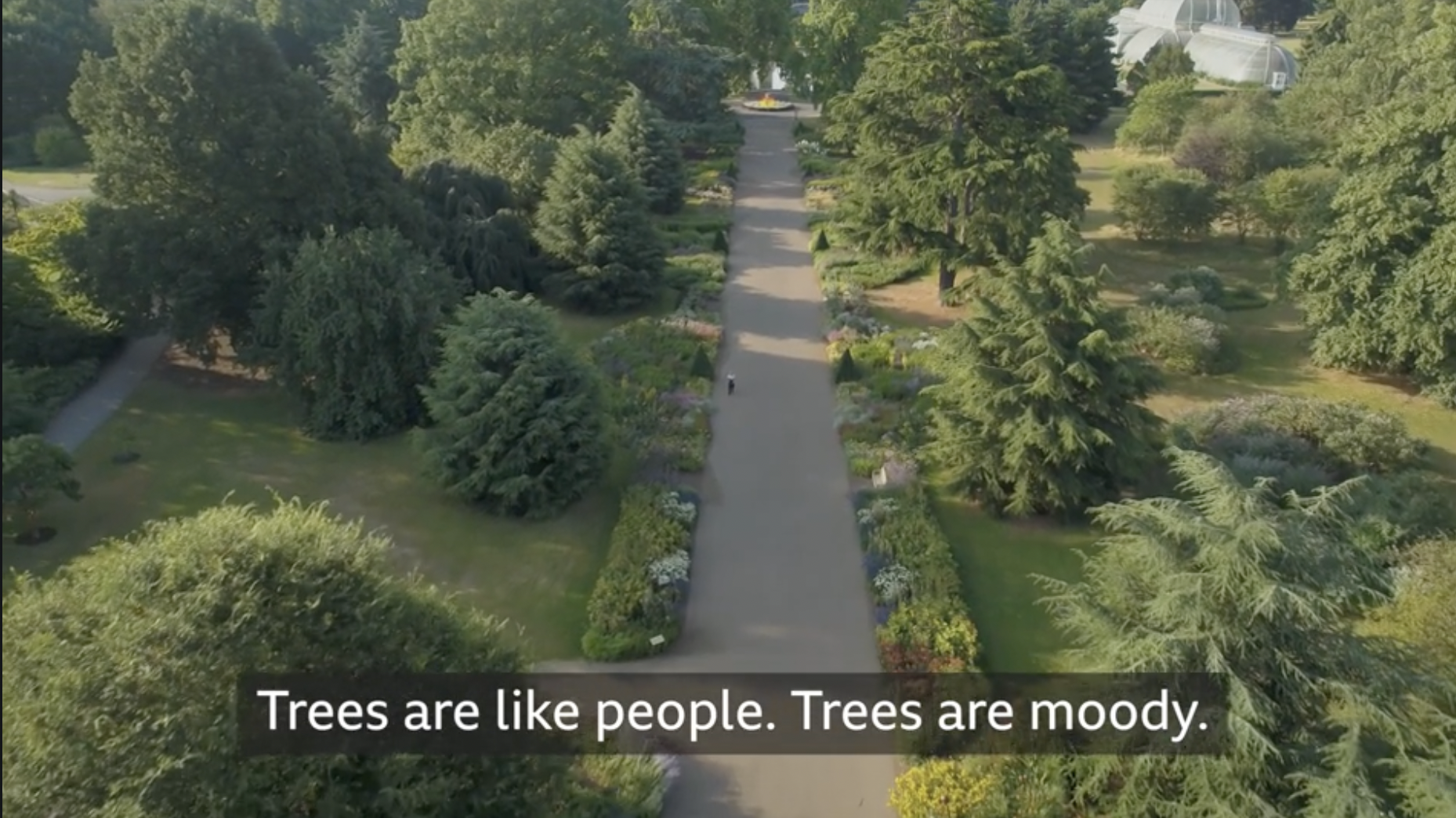
Christle’s book led me back to Woolf’s essay “Street Haunting: A London Adventure” in The Yale Review:
“But what could be more absurd? It is, in fact, on the stroke of six; it is a winter’s evening; we are walking to the Strand to buy a pencil. How then are we also on a balcony, wearing pearls in June? What could be more absurd? Yet it is nature’s folly, not ours. When she set about her chief masterpiece, the making of man, she should have thought of one thing only. Instead, turning her head, looking over her shoulder, into each one of us she let creep instincts and desires which are utterly at variance with his main being, so that we are streaked, variegated, all of a mixture; the colors have run. Is the true self this which stands on the pavement in January, or that which bends over the balcony in June? Am I here, or am I there? Or is the true self neither this nor that, neither here nor there, but something so varied and wandering that it is only when we give the rein to its wishes and let it take its way unimpeded that we are indeed ourselves? Circumstances compel unity; for convenience’ sake a man must be a whole. The good citizen when he opens his door in the evening must be banker, golfer, husband, father; not a nomad wandering the desert, a mystic staring at the sky, a debauchee in the slums of San Francisco, a soldier heading a revolution, a pariah howling with skepticism and solitude. When he opens his door, he must run his fingers through his hair and put his umbrella in the stand like the rest.”
*
In poetry, I’ve been working my way chronologically through Louise Glück’s work. From “Cottonmouth Country,” in her first collection, Firstborn, published when she was 25:
Birth, not death, is the hard loss.
I know. I also left a skin there.
And from “Marathon,” which came from her fourth collection, The Triumph of Achilles:
I got up finally; I walked down to the pond.
I stood there, brushing the grass from my skirt, watching myself,
like a girl after her first lover
turning slowly at the bathroom mirror, naked, looking for a sign.
But nakedness in women is always a pose.
I was not transfigured. I would never be free.