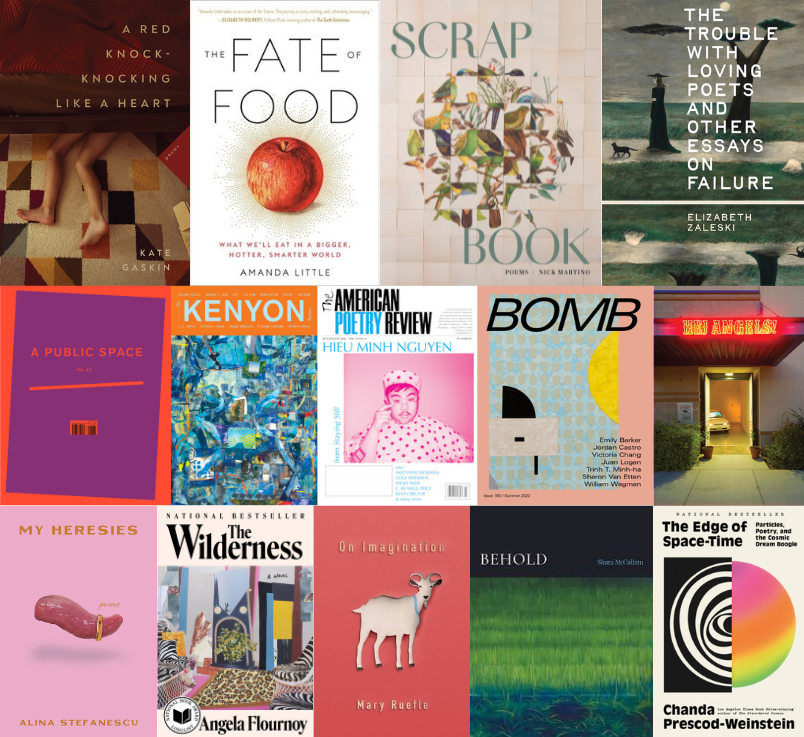
Summer has slid by, almost without notice. Lately, the heat has been giving way to torrential rain flooding parts of the city. A crack in my ceiling emerged during one storm, the leak soaking a pile of books and papers (none of them important). The summer felt both slow and quick, a blur of events, a swimming pool here and there. Here is what I read during the hot months in Nebraska:
In June, I read Kate Gaskin’s second collection, A Red Knock-Knocking Like a Heart (LSU Press)—another collection that I had the immense privilege of seeing in its early stages in a full-length manuscript workshop run by Hope Wabuke. It’s a gorgeous and tender book, and I recommend it.
I started to read The Fate of Food, but it’s proving to be a slow summer read; I dip into it every now and then.
I read Nick Martino’s Scrap Book (Alice James Books) a delightfully inventive debut collection. I especially enjoyed the polaroid form Martino uses—an erasure in reverse order (the photo developing).
I spent a good part of this summer catching up with some literary journals. In June, I started with the latest issues of A Public Space and Kenyon Review. Favorites from those issues:
“Before I Forget” by Fiona McCrae in A Public Space: “I always knew you could forget individual memories, but I only learned that memory itself could desert you when my mother told me, around the age of fifteen, that my grandfather was losing his. I tried to picture what that might mean. We can’t even eat a bowl of cereal without memory—we need to remember what cereal is, what a bowl is, what a spoon is for, and how far it will be to our mouth. Living in the present, it turns out, involves past and future.”
“Flinching Dog” by Parker Menzimer in A Public Space: “I’ve thought I would kill for a mind like that / that entraps all the trivial flecks of the world / in a net like fishes that, once caught, never rot / a mind daily trained on its cold, cruel precision / good for detective work, good for making life into art”
“Ecstatic Past” by Alicia Mountain in Kenyon Review: “I don’t know how else to say it. My life / was very small and beautiful. I was young / though I didn’t know it. I was happy / when the lilacs filled the alleyways in June.”
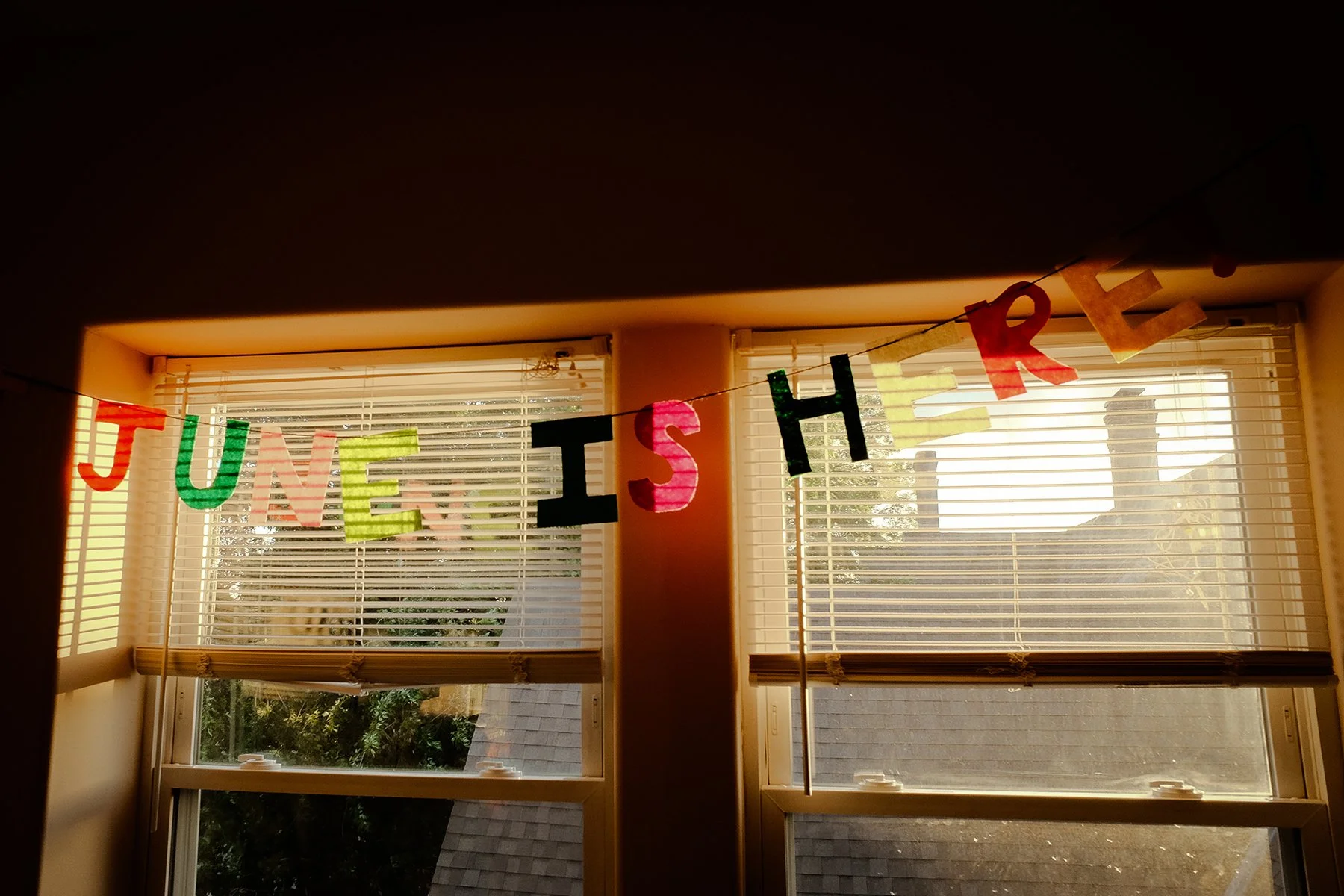
We had a birthday party for my kitten, June, because life needed a little silliness.
In July, I started reading Elizabeth Zaleski’s essay collection, The Trouble With Loving Poets and Other Essays On Failure (what a title!). A major highlight so far has been this essay, originally published in The Missouri Review, which begins “I didn’t set out to find a big penis.”
I read the latest issue of American Poetry Review, which included Holly Coleman’s wonderful essay “The Erotics of Grammar.” A few favorite moments from that essay:
“Maybe what we want from grammar is reassurance: that we can live together inside one syntax without tearing it apart.”
“Language is a skin, but it’s also a crowd. Every comma is a small negotiation with everyone who has ever paused there before you.”
“Perhaps love, like grammar, is measured by the pauses we allow each other.”
I went back in time to read the summer 2022 issue of BOMB Magazine, which included an interview between Jane Wong and Victoria Chang. They talk about one of my favorite collections of Chang’s, The Trees Witness Everything (Copper Canyon Press). I love the way Wong describes reading the collection: “I felt as if I ‘hit a World, at every plunge,’ to quote Dickinson. Each poem was an expansive cosmos packed into a tiny space. It felt almost as if my foot would get stuck in one of the poems and then I’d have ti pull it out from quicksand to move on to the next one.”
I read My Heresies by Alina Stefanescu (Sarabande Books). There, I discovered one of my favorite poem titles I’ve come across recently: “I Nominate the Linden to Continue Its Service as Tree of Longing and Aromatic Futility.”
I finished the month with the new summer issue of the Georgia Review, and was delighted to find new poems by Adele Elise Williams and Knar Gavin. From Gavin’s poem “NYE, 2024”: “And so, in / sofar // as revolution / is repetition, there is that / love for which you too would surge / at any barricade, imagining it the last.”
Also, this poem by Alina Nguyễn stayed open in my tabs for a long time. “When you are not meant to / remember / how you were born, / you remember everything else.”
In August, I started the month by doing a reading at Chapters Books in Seward, NE with Colleen Morton Busch, whose latest collection, Smolder, was recently published by Ex Ophidia Press. I keep thinking about a poem about a dead hummingbird poem she read, which begins: “I can’t bear the thought / she’ll be crushed beneath a sneaker, / so I find two twigs / to hoist her off the sidewalk, / lay her under juniper.”
I read The Wilderness by Angela Flournoy, which kept me company while fighting off a summer bug.
I read On Imagination by Mary Ruefle, published by Sarabande Books. Here’s a passage where she quotes Michael Burkard (her husband; my former teacher; he passed in December of 2024):
“The imagination is more like the moon than the sun because it is dependent on another thing and exists in no pure state by itself [the way the light of the moon is the reflected light of the sun, and has no light of its own]. It needs an openness to whatever is there at the moment and to not reject whatever is there because of any formulaic concept from out of the past. […] The imagination is not a privileged act; everyone engages in it. The imagination allows me to give a credence and an integrity to any existence outside of myself. […] I like to think of it as ‘spooky behavior over long distances,’ which is how scientists describe those electrons that respond to each other though far apart. Spooky behavior over long distances, that’s it. You can feel its presence.”
Currently, I’m reading: Behold by Shara McCallum, forthcoming from Alice James Books, and The Edge of Space-Time: Particles, Poetry, and the Cosmic Dream Boogie by Chanda Prescod-Weinstein. The latter is making my head spin, trying to find its way around definitions of space-time and relativity, but I love Prescod-Weinstein’s approach, which centers metaphor and storytelling in the way we communicate all things—including science. There’s also a beautiful insistence on being comfortable in the not-knowing. I was describing it to a poet-friend the other day, who replied “I think poets are probably the best at being comfortable in not knowing things.”
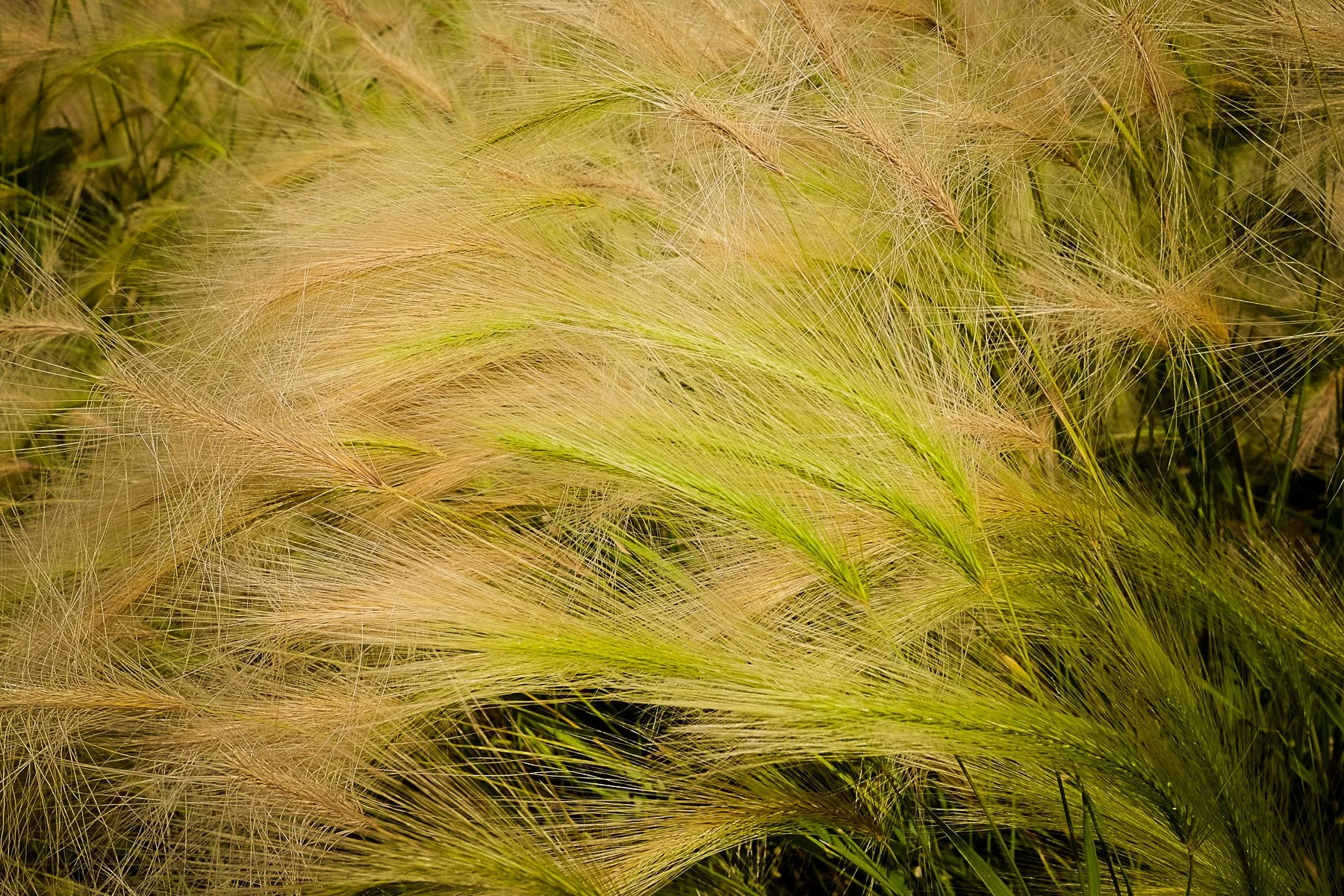
Summer grasses on UNL’s campus
Through all this reading, I’ve also been writing. I won’t say much more than that, afraid to jinx it; the last time I was in a writing space like this, I talked about the project far too much, and it died in the air. But I will say that it’s a relief to have regained access to a creative space-time (there you go, Chanda) in which I feel the freedom to play. And maybe nothing will come of it, and maybe something will; the point is the process, not the product.